Saturday, June 22, 2013

K-noa: Night and Day

"Todo bien?"

"Claaaro, to' bien."  Hang-loose sign, bro nod, peace sign, salute, slap five and knuckles.  So the greeting goes.  All good?  Definitely.  Off to the beach, or course it's all good.  

What could be bad in Canoa?

Well, It could rain a little.  It might be windy making the surf choppy, or the wind could be coming off the ocean making the waves too humongous for you.  It could be "chilly."  But we're from Vermont, and the Pacific is always warm -- that's like the briar patch for us -- our kids swim in the North Atlantic in August, until their lips turn blue, which usually takes about 30 seconds.  But in Canoa, you could get sand in your pants.  A rash on your chest from surfing.  A restaurant might be out of strawberries for your smoothie, so you go with raspberry.  In Canoa, there isn't much to worry about for the average tourist.  

But Canoa is a working town, too.  Tourism does not seem to have eclipsed fishing, at least not yet.  Not like it has in other Ecuadorian fishing towns like Montanita.  A couple dozen panga boats line the beach, mingling with the shade tents you can rent for the day for 3 or 5 bucks.  Every day, through high season and low, the fisherman come down the hill bringing their outboard motors and nets on three-wheeled bikes.  Regardless of where the tide is, they head out in the morning and come back one at a time, from the late afternoon through dusk.  


Rolling the boats down into the tide must be relatively easy.  To get them back up the beach requires five or six people to push.  The dudes come flying into the breaks, right between the surfers and the swimmers, gunning it all the way to the beach, where at the last second the driver cuts it, tips the motor forward hauling it out of the water, prop still spinning.  In the meantime, another guy has jumped out of the boat and is in the process of turning the nose into the surf.  It takes a wave or two to complete the one-eighty, and by then, all two or three guys are out of the boat.  One of them has gone up to drag the rollers back down.  Or they've called ahead and a young boy from the family, who's presumably too young yet to man a boat, is dragging them down.   Or he's kicking them, one at a time, rolling them with the bottom of his foot.

But first they've got to get the nets wrapped up into huge bundles, often carried two at a time slung on a pole, their weight bending the bamboo.  Then comes the motor, where one guy shoulders it and makes a run for the high tide line where the three-wheeler is waiting, and hopefully a partner since he can't lower the motor himself -- it takes two people to drop it, lean it against the trike or another boat 'til they're ready to head up.  


Once they've got the gear up on the beach and out of the way of the tide, they start cleaning fish.  By this time, there's often a group gathered around the boat haggling for the catch, restaurant owners and regular people too.  Usually there is a swirl of frigatebirds signaling the arrival of the catch.  If you're wondering where to buy some fish, just look for the frigatebirds.

Sometimes they'll bring the boat up before unloading the fish.  Either way, the boat has got to come up every day, just as it's got to go down.  Using two ten-inch diameter logs, usually fixed with ropes tied into grooves at one end for dragging, the boat is rolled up the beach.   At low tide, the beach is relatively flat.  A couple guys weight the bow of the boat (pointed into the surf), and someone sneaks the roller under the stern.  Then they roll it forward to the balance point, where the second log is brought around and slid under the stern, the first having rolled under the bow.  Then the leapfrog begins.  Roll beach-ward to the balance point, bring the back log around to the front and put it under the stern while the pushers weight the bow.  Roll forward, and repeat.  Finally, they hit the softer sand, where the rollers are best put on a couple of sticks of bamboo, to give the logs some lift on the soft beach sand.  Here, the beach is the steepest, and passersby often stop to help push the boat up the last steep pitch -- heave, rest, back roller to front, heave… until the boat, facing the sea, is safely above the high tide line and ready for tomorrow morning's work.


If you help push a boat up on the beach, you get free fish.  I only helped a couple of times, and neither time did I ask for fish, mainly because we can afford to pay for seafood.  Like a lot of Ecuador, there is a stark contrast between rich tourists and work-a-day people living, literally in this case, hand-to-mouth.  We met a beer vendor named Giovanni, who makes a quarter a beer, sells a case a day.  On bad days (overcast, no tourists, few sales) he helps push boats ashore before walking off with a bag-full of small fish to feed his family of eight.  Giovanni and I are the same age, and it hits me that we could so easily find ourselves in different situations.  Tourists, at least a lot of us, are wealthy by virtue of the fact that we are here, by virtue of the fact that every dollar we saved in the US is three or four in Ecuador.  The fact that we have round-trip tickets and will be returning to our work, homes, schools, etc.  Even most "poor" gringo backpackers have parents at home to bail them out if something happens, have $400 backpacks, $100 shoes, those colored water bottles no one here understands; even if they're on a tight budget, it's temporary -- we're headed back to the US to continue consuming a disproportionate amount of the world's resources.

If anyone minds this in Canoa, they don't say so.  At least not that I heard in the three and a half weeks we lived there.  Of course, we're a different sort of fish.  But like the rest of Ecuador, there are plenty of Ecuadorian tourists patronizing the beach, especially wealthier quiteños who fill the town on weekends.  So goes the pulse of the town: Monday through Thursday, business as usual, handsfull of backpackers and surfers and fisherman enjoy a lot of space on the beach; by Friday, the Quito tour busses and streams of cars arrive, the hostels fill, and the palapa bars, dozens of which line the beach pulsing with awful techno-cumbia music, competing it seems with volume to lure patrons into their wall-less establishments.

But Canoa has a dark side as well.  One morning Kerry had gone out for some milk, and there were crowds of people outside the local public health clinic.  There was a young man lying in the back of a pickup truck, presumably shot in the face.  Townspeople gathered to gawk; the immediate family huddled, hoping for the impossible; surfers in their own clique chatted, uncharacteristically serious.  The bomberos showed up in their emergency vehicle, hopped out of the truck with a backboard, hustling over to the pickup where they took a look at the prospective patient.  One guy shaking his head, one glance at the young man was enough to confirm the obvious.  They headed back to their truck, much slower than their arrival.  He was a lost cause.  

In contrast to the shock and grief of most of the townspeople, two men next to their motorbike glared at the crowd, one talking angrily into his cell phone.  Suddenly, the phone-guy came forward, shoving his way through people roughly, still talking into his device.  Observing the man in critical condition, he seemed satisfied, pushed his way roughly back to his bike, and the two zoomed off.

"Those were the killers," said our landlord, Mr. Fabio two days later.  "Mafia."  The generic, looming presence of organized crime.   Emissaries of death.  The kid did not live, and the rumors swirled for the next couple of days.   There was a theft, it was revenge, and so on.  But Mr. Fabio made it simple: it was a hit.  No need to imagine the motives; there are only one or two possibilities.  

Signs also warn people to stay off the beach at night.  It's not safe, especially for women.  Rape is a big problem in Canoa, and the victims are almost always gringas, sometimes lured onto the beach by one of the many surfer dudes.  He might ask a girl if she wants to smoke a joint, and when they arrive on the beach, a few of his buddies are waiting.  This is not to say that all surfer dudes are rapists, but a few are.   And everyone there seems to know it.  If you are a single backpacking woman, you can expect some aggressive attention from some of these guys, and if it's consensual, then more power to you.  We saw some of the same dudes in January with new, different backpacking girlfriends in May.  Who knows how many there were in between.  

But if there is sexual violence, there isn't much follow-up from the police who -- as it's invariably a tourist since no Canoan woman would ever go out late -- will blame the victim.  "What was she thinking going out on the beach like that, with that guy, at that time?  She must have wanted it."  If there were violence perpetrated against a local woman, vigilante justice would rule.  In nearby San Vicente, two robbers shot a guy in cold blood because they knew he had a lot of money.  Next day, half the town saw them stoned, hung, and burned.  From what I hear, the police don't mind this kind of justice at all since they turn a blind eye and no investigation follows such an event.  

For itinerant travelers though, there is no such reaction.  The Peace Corps has apparently declared Canoa too dangerous for its young volunteers.  I ran into one guy at a bar, a gringo tourist who'd obviously been beat up.  He'd heard a girl scream, gone out to help, fortunately giving her a chance to run off.  But her escape left the frustrated would-be molesters to take their aggression out on him.  

To most of this, we remained blissfully oblivious, a family in an apartment in a well-protected, well-sealed hotel who went to bed by nine.  We were never threatened.  To us, Canoa was sleepy, tranquilo -- a paradise for our children who had the run of the beach all day long.  We met many wonderful people, both locals and travelers, gringos, Europeans, and Canoans.  We were made to feel at home in our little rented compound, and our kids played with the hotel owners' kids.  


Like many places, Canoa has two distinct cultures: the day culture and the night culture.  Unlike many places, night and day overlap quite a bit.  I don't mind a little nightlife now and then, but now that I'm old(er), I keep it pretty mellow.  Clearly as a family, we inhabit the day and are oblivious to much of the night-life.  And that is fine by us.   We learned to surf.  We played in the waves.  We ate awesome food.  We made friends.  We slowed down to the rhythm of the days, defined by the pulse of the tide.   "Todo bien?" is as much an affirmation as it is a question.  And for us at least, it was.

Friday, June 21, 2013

Field Trip: Cotopaxi

Here's the photo-story for my friend Pete and my attempt on Cotopaxi Volcano, Ecuador's second highest peak (19,347') and the world's third highest active volcano.  We were turned back about 300m from the summit by my altitude sickness and bad weather/ice-squalls.  The write-up is forthcoming.  As ever, the pics look better as a slide-show, which you can start by clicking on one of them.  Thanks for being interested!

The approach by road to the Refugio Cara Sur de Cotapaxi (south face refuge), which you can see on the hill in the middle below the glacier.
The refuge and property that it's on are privately owned by Don Eduardo, who also runs the guiding company we used.  The property abuts the Cotopaxi National Park.  Most Cotopaxi climbs start on the more popular north face.
Eduardo's new sunroom at the refuge.
Salud!
Eduardo's LP gas modified Land Cruiser
View from the refuge, about an hour off the last "main" road and high in the paramo.
At 4000m the refuge sits just below my highest acclimatization climb (4600m).  This would later be a problem for me.
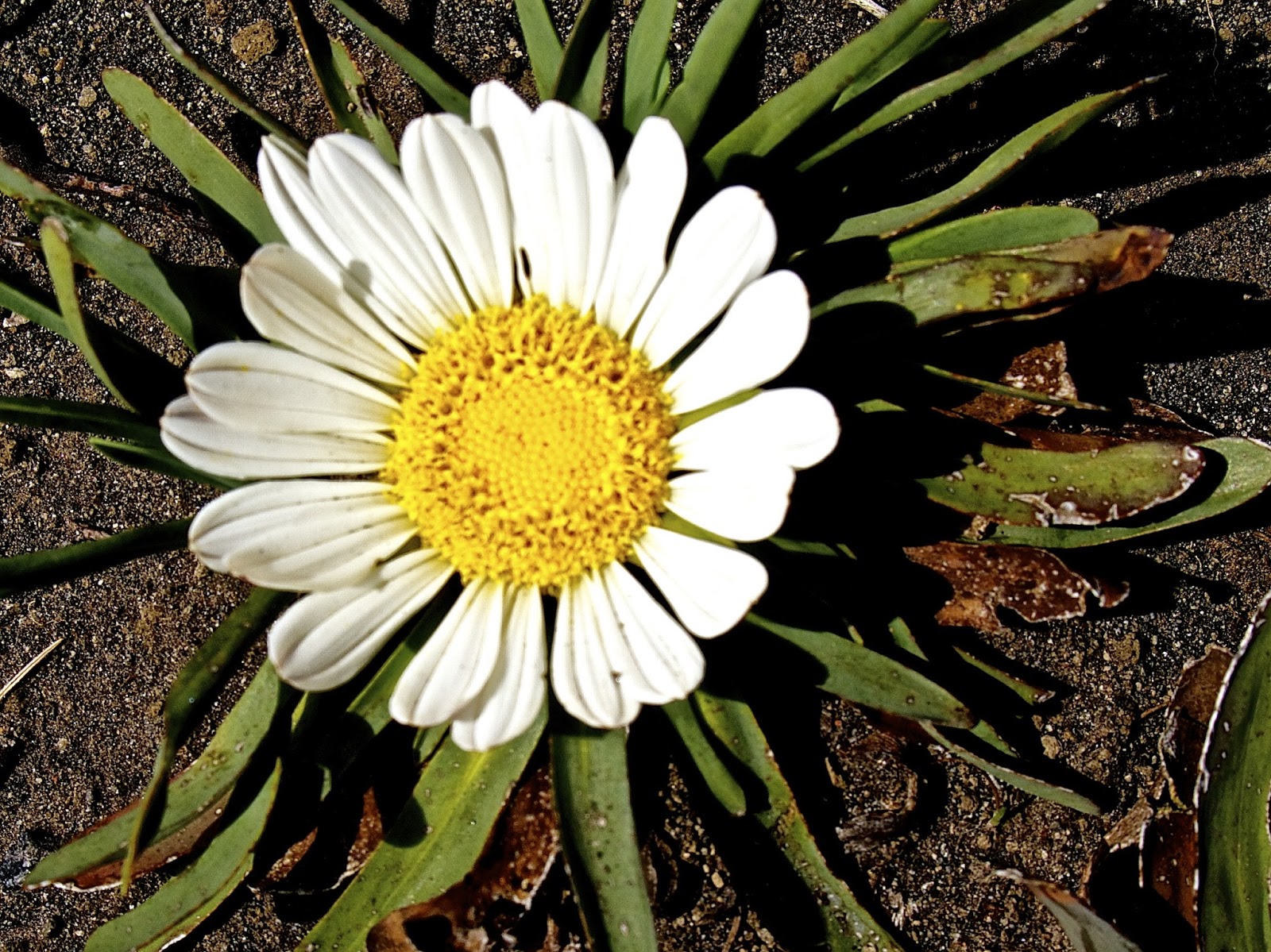
Wildflowers of the paramo were abundant.  I even, finally, caught the paramo dwelling Giant Hummingbird.

At 2 PM, after getting our gear, we headed out on the 2 hour hike up to base-camp.
One of many rainbows on the way up and down, this one sits in a quebrada (or gulch).
Cotopaxi giving one of its rare views for the day.

Chispas the glacier dog accompanied us up to base camp, but declined the summit attempt though photos at the refuge  are testament to his many successful trips.  Chispas makes his own calls in the morning, and his was probably a good one.  The weather did not cooperate, and it was cold even by the guide's standards.
Almost to base camp, you see one of the tents above Pete and to the left.  The illusion of distance is evident here: it would take us an hour plus to make it to the glacier from that tent.
Views around base-camp

Sunset on the volcano.  The summit looks so close, but is 5-6 hours away.
Our palacial digs.  The white tent is the kitchen.  We'd eat dinner and hit the sack around 7 for the midnight wake-up call.  All hikes start early, when the snowpack is more stable, and thus much safer.
This is Segundo, our excellent guide.  He knows Cotopaxi well having climbed it some 100 times.  He didn't have a specific number when we asked, but 100 seemed like a conservative guess.  In fact, he didn't even use a headlamp (he'd forgotten to get batteries) even with our 1AM start.  When we descended in the early morning light, we saw the crevasses he'd navigated without the aid of light. 
Here is Pete packing up his crampons and harness, shortly after we'd climbed off the glacier.
Here I am, still feeling about as bad as I ever have, thanks to hitting 5600m of elevation (or 18,000+ feet).   There are no pictures on the glacier since taking off my pack, extracting my camera, and snapping pictures required an unthinkable amount of effort.  Even re-tying my boots once took more energy than I cared to expend.  
I remember the conversation Segundo and Pete had and the decision to turn back.  Though I was mumbling incoherently and stumbling, the effects of elevation and lack of sleep on my brain, I remember everything clearly.  Just 300m would have taken another 1.5 to 2 hours, which was unthinkable in my condition.  Also, squalls were battering us with ice, and the summit was enshrouded in a storm.  "I've known this guy for 26 years," Pete said, "it's not about strength or conditioning; it's the elevation."  At that, we all agreed to turn back.  You don't take chances up there, and I am grateful to my friend for taking care of me on the mountain.  We are tethered together by more than a rope, for sure.
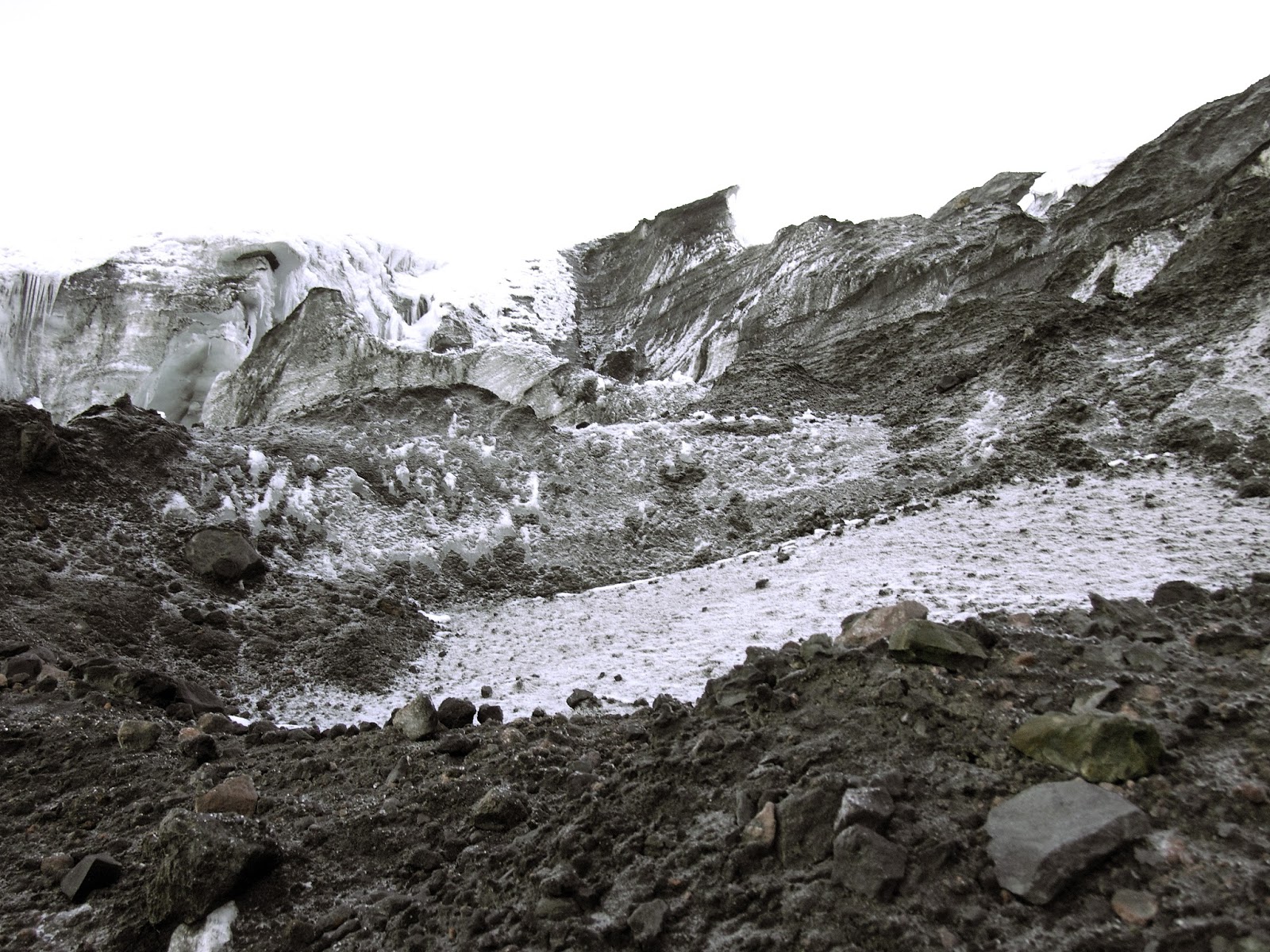
The edge of the glacier.
Hombres fuertisimos
After some tea and a nap at base camp, still feeling ill, we had to head back down to the refuge since the weather was threatening to turn again.  It looks sunny, but it spat rain all the way down.


With each step down the mountain -- and sip of water -- I felt the effects of the elevation wane.  We were treated to rainbows again, all the way down to the paramo and the refugio.
While our summit attempt was not successful, the trip was.  What beautiful country, and what a blessing to be able to experience it in all of its extremes... and to make it back safely.  


Tuesday, June 4, 2013

Surf v. Schuss

Most who know me know that I like to ski.  A lot.  So taking a year off of skiing hurt.  A lot.

¨It's good for you.  To take some time off is good,¨ says Kerry, twice emphasizing the word ¨good,¨ like a parent trying to sell a kid on a plate of kale and brown rice.  I´m not really sure how that could be, but I nod and I act like I know that she's right, like I've learned to do when I know something´s good for me. 

But I know better.  It´s been bad for me.  Every time I checked into the snow conditions at home, a tiny piece of my soul fell off and floated away like a melting glacier stranding my inner polar bear on a tiny piece of ice -- even if they were bad.  Actually, especially if the conditions were bad.  Suffice it to say the shift to a snowless year was not an easy one to make.  On the two occasions I felt the sting of sleet or hail this year, I was ectstatic out-of-my-head to be pinged upon all-but-briefly by the frozen version of precipitation.  It´s not healthy I know, but there are worse things to need.

If this is how you see a beach, you may have a ski problem.
Yes, I´ll admit that this is a relatively minor sacrifice.  I´m really OK with it.  It´s been better than gangrene.  And while I´ve sorely missed the winter, I have not once regretted this choice to spend a year on the equator.  It's a trade I've made willingly, and would do again in a high elevation heartbeat.  I have a bike after all.  And I do love biking, skiing's slightly less fun/more hard work cousin.

But when we had the chance to live for a few weeks in a surf town, it was clear that I'd have to give surfing a shot.  And boy did I get my gringo sombrero handed to me, even on a forgiving beach on a forgiving day.  Just like skiing, there are people who make it look just so easy -- and so fun, especially to the novice gaper who admires from the beach.

So it's not at all fair, and I am way far from qualified to make the comparisons that I am about to make.  I'm a black diamond skier and at best a green circle surfer for now.  But here -- I will indulge myself in another little excusion in the realm of hypothetical mutual exclusion, to wit: Surf v. Schuss.  Let´s assume, for argument´s sake, that the skiing we´re talking about is backcountry, earn-your-turns-style off-piste skiing.  No lift-served access to the goods, an no wave-runners towing people out -- just good ol´ masochistic fun. 

So let us begin with that: both skiing and surfing require exertion.  You need to till the soil in order to reap your bounty.  For skiing, you go up so that you can go down, often coming back by the same chute you ascendend.  For surf, you paddle your arse out so that you can ride back.  Both surf and ski conditions are variable so that heading up or out might be relatively easy.  Or it might be a real mofo.  I have seen more than a few hapless would-be wave-cowboys get bashed to bits right there on the beach because they´re trying to head out at high tide.  I have been that guy.  And having eaten my slice of humble pie and some, I have limped off the beach with a sore leg/arm/head.  So too with skiing, skills combined with conditions affect the experience.  Conditions may vary.  Once in CA, Cap´n Furthermore and Co. toiled upwards through thigh deep heavy powder for a couple of hours, only for it to be too much snow to ski!

As for the slide-media, snow obviously makes for good skiing, though the quality of the snow can differ widely, even from hour to hour.  Optional for some -- the skiing is admittedly better with more than a few inches of the good stuff, and surfing requires waves with enough force to push the rider forward.  It takes a skilled and experienced skier/rider to read the terrain/waves.  In both cases, the topography that lies beneath greatlty affects the outcome for fun-seekers on the surface.  Again, treading in ObviousLand, the steepness of the slope and the ¨features¨ under the snow shape the surface experience.  Wave-riding is more 8th grade science class: a wave breaks when its height is twice the depth, so the shape and slope of the beach -- or worse, the reef -- determines the break of the waves.  I´ve been pretty fortunate to learn in Canoa, EC where all of the waves break on sand, and the sub-surface is just a gentle slope.  

In both sports wind can be your best friend or your dreaded enemy, though the fact that wind actually makes waves gives surf the edge in the air-blown category -- though if you allow that wind moves weather in and out of your favorite ski lines, we´d have to agree that both sports are entirely wind dependent enterprises, directly and indirectly.  Wind sends the waves in from hundreds of miles off the coast, which gives surfing the edge in the existential philosophy department.  It´s cool to paddle into the energy of a wave that´s travelled a bazillion miles from the first flap of a butterfly´s wings to give you a gnarly sesh.  But wind on shore can create chop, which affects the waves coming in adversely.  So a calm day with big waves is ideal.  A couple of days ago, I surfed some ¨clean¨ waves, and was amazed at the difference.  Like slashing fresh powder, it´s hard to beat the optimum conditions, and if you´re like me, once you hit it on a peak day -- and you get your mojo working at the same time -- the hook is in, and you´re all done.*

As far as aesthetics, it's always something to witness a master at work in any eneavor.  As for surf'n and skiin', you can do that more easily with surfers, unless you're watching the ski comp on TV.  In both athletic realms, more importantly, it's about carving smooth lines.  My friend Professor Duffy astutely points out that the history of your ski line is immediately visible in the frozen medium.  Not so in the ephemeral surf, where your tracks are snuffed out almost as soon as they're made.  A clean set of lines or 8s in the snow is a work of art, but it's also an indicator of the snow quality or the stability of the snowpack.  Skiing gets the clear edge here for post athletic-aesthetics, as well as safety record for a slope. 

Both sports feature people upright on boards, although in surfing you start out horizontal, get vertical, and then most likely go horizontal again -- or you get thrashed by the spin-cycle, in which case you´re happy when you´re back on that board.  In skiing, you start and end vertically, though there are often a few horizontal interludes, with an occasional ragdoll yardsale, in which case, you may happily recollect your belongings once the world stops spinning and you´ve regained your verticality.  It's also worth noting that you'll never cross your surf boards, though in each medium, you can bury a tip/tips and go flying.  Always better to keep those tips up.

The two pastimes also require wax on these boards. For surfing, the wax is applied to the top in order to stick and stay (ideally) in one place, wheras with schuss-centered sports, a wax is applied to the bottom of boards in order to reduce the effects of friction.  For skiing, you need several kinds of wax, depending on the temperature.  For surf, you choose the color and the brand.  Mr. Zogg´s Sex Wax (tm) T-shirts were really, really cool in high school in the 80s.  When feathering my hair and donning my checkered vans, I did not forsee my 42 year-old self using surf wax (let alone knowing what it´s for), nor did I see gobs of it becoming entangled in my chest hair.  For this, I have to give the edge to skiing in the wax deprartment since no chest hair is involved at all, at least it´s not required.**

But It´s pretty easy to tell which sport requires less stuff: beach bums take this department by a wide margin.  Surfing requires one board, some shorts which are optional though recommended, probably a rash guard and some wax -- get that, and you´re all set, brah.***  The list for skiing equipment would require a scroll used to chart Japanese ancestry back to the first Shogunates. 

One thing I have to give skiing is that you can carry snacks with you.  And beers.  Then again, you don´t worry about your beers freezing solid when you´re chilling in the Surf Shak with a cold one.  If you want to take a break from surfing, you have to get to shore, esentially stopping the activity.  Then again, you don´t have take boots off to warm your toes on a fire.  I guess that´s another draw in the accessories catagory, with simplicity cancelling out luxury.

One thing that I have to put clearly into the ski column is that you are not likely to be chomped on by a shark while skiing.  To be sure, there are plenty of dangers on snow.  Take your pick: hypothermia, avalanche, tree-well, snow-snake, rabid wolf packs, blisters the size of pancakes... But you can rest assured that you will not be shark-bait.   Nor will you bleed to death or drown after a Great White samples the seal-looking thing flapping around on the surface and decides it´s too gamey or rubbery.  No drowning, jellyfish stings, nor reef raking.  All that said, I´ll bet that the mortality rate for skiers is higher, maybe since more people do it.  I base this assertion, by the way, on absolutely nothing.  Another zero sum.

Which requires more effort?  Being half the expert, it´s hard to say, but I know I'm expending more energy than I need to at this stage in the game.  That said, I´ll give it a draw in this department as well.  Or at least the apples and oranges toss-off.  BC skiing is as hard as you want to make it on the climb.  If you´re laying a skin track in powder, give yourself a triple bonus -- especially if it´s witch-tit cold.  But hitting laps on a bluebird day, that´s like a leisure stroll in the park.  Skiing is a long distance run, and surfing is a bunch of sprints -- though you can take as many breaks as you like with either.  And again, it depends on the conditions.  And here in Canoa, you can just walk out to chest-deep waters and saddle up.  In all though, a surfer definitely has to be more fit whereas a skier can or might be more (or less) fit.

Finally, which sport has a bigger payoff?  Which one sets the endorphins and adrenaline surging better-farther-faster into the bloodstream?  That´s ultimately the question, isn´t it?  Since for now surfing gives me as much pain as pleasure, at best for now, I prefer skiing.  Not sure I could say that if I ripped like some of the locals around here.  Which also reminds me that coolness is often a measure of... coolness.  And the coolest surfers are waaay cooler than the coolest skiers.  For evidence, see how surf culture has influenced the midwest way more than ski culture.****  Still, it´s been fun.  Obviously, you can do both.  But the travel costs would be inevitable, prohibative for many.  I know that you can ski in Hawaii and surf in the North Atlantic, but I´m not sure why you´d want to.  In either case, you have to get it while you can.


* But surfing is harder and slower to learn.  Hands down.  For more analysis, see "cool" category in the closing paragrap.
**For the record, I use grape flavored Sticky Bumps brand wax.  You can smell the grape pixie stix smell when you mount the board.
***Not counting New Hampshire or Ireland in February where dry-suits are required.
****I use the midwest for an example, but I really mean Iowa, where there are no surfers and very few downhill skiers

Tuesday, May 7, 2013

Volcán Imbabura

Volcán Imbabura
  • Elevation: 15,190'
  • Hasn't erupted for 14,000 years,
  • But not listed as "totally dormant"
  • Occasionally brushed with snow,
  • But mostly snow-free
  • Not part of the double Andes range;
  • It sits by itself, between them

Native Otavaleños and Kichwa peoples around the Volcano believe he is Taita Imbabura, or Papi Imbabura, a protector of the valley.  Though said to be a womanizer, he is "married" to Cotacachi, a volcano across the valley, on the western range of the Andes sierra.  If Cotacachi has snow on her peak -- which is fairly common -- it is said that Taita Imbabura has visited her in the night.  And Papi Imbabura has a heart.  If facing the volcano from Otavalo, there are three distinct foothills, and the double bowl-shaped quebrada, or Heart of Imbabura, is located in the western face of the southernmost hill.  The heart is thought to be enchanted, since no one and supposedly nothing can get in there.  Except Cotacachi apparently. 

Imbabura looms over Otavalo, and if not socked in by clouds, we see him every day.  He shows up in logos around town, and in many of the photographs we've taken in the area.  I thought I'd compile a collection here of shots from the last nine months, from various sides and angles -- and even on top -- though most come from the Otavalo side, where we live currently.


As always, the photos look better as a slide show -- click on any one to start it -- and thanks for looking!